Place and purpose
South Stack marks a dangerous coast rather than a lone reef far offshore. That changes the design problem. The tower has rock beneath it and land close by, but the site is still severe. Cliffs, swell, wind exposure and poor visibility all affect the station. The lighthouse must be seen by vessels using the approaches around Anglesey and the Irish Sea.
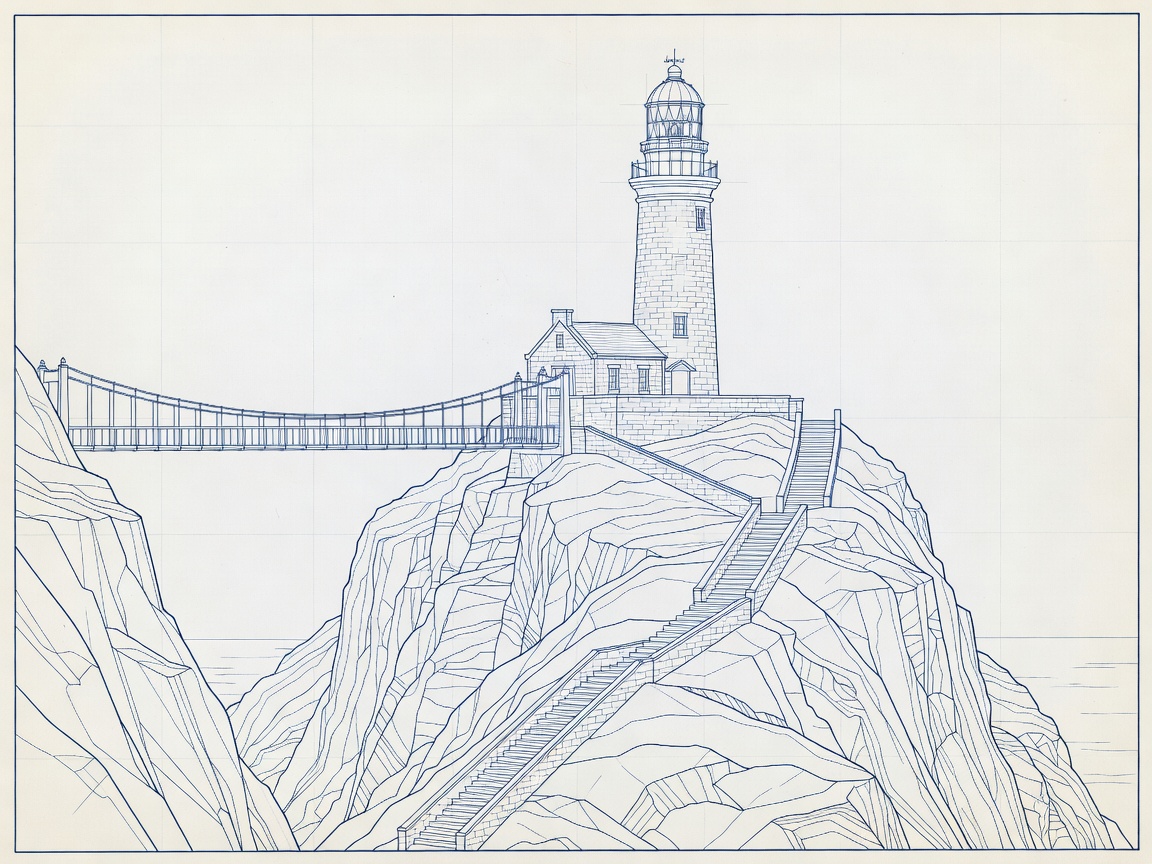
The station’s value lies in its combination of elevation and position. A cliff can give height without an exceptionally tall tower. That helps the light’s reach, but it also changes maintenance and access. The builder does not fight for every course between tides in the same way as at Bell Rock. Instead the problem shifts to steps, paths, bridge connections, landing arrangements and the movement of equipment between land and tower.
South Stack is administered within the Trinity House system. That places it in the same broad authority structure as Eddystone, though the physical site is very different. The comparison is useful. One is an offshore rock tower where foundation mass dominates the story. The other is a cliff-edge station where approach and signalling environment are more prominent.
Access design
Access is not secondary at South Stack. It is a design condition. A lighthouse that cannot be reached cannot be maintained. The well-known descent by steps and the crossing to the stack are part of the station’s working anatomy. Visitors may notice the drama first. Engineers notice the logistics: how keepers, fuel, lamps, tools and later electrical equipment move safely enough to keep the light in service.
A cliff station can use shore support more easily than Skerryvore or Fastnet, but it introduces vertical effort. Stairs, rails, hoists and paths must be maintained against weather and salt. The bridge is not a scenic accessory. It carries people and equipment across the gap that makes the stack a defensible site for a light.
The tower itself can be less massive than a wave-washed reef tower because it is not taking the same direct sea impact at its base. That does not mean slight. It still has to carry the lantern, resist weather, protect the optic and provide safe working spaces. The foundation question becomes one of rock seating and exposure, not of continuous wave attack on lower masonry.
Signals and optics
South Stack demonstrates how a lighthouse works as a set of signals. By day, the white tower and its position against the cliffs serve as a mark. By night, the light characteristic identifies the station. In poor visibility, fog signalling has historically added another warning, though sound remains variable at sea.
The optic follows the general development seen across British and Irish lighthouses. Earlier light sources and reflectors gave way to more efficient lens systems. Fresnel optics allowed stronger concentration of light and more controlled beams. The station’s characteristic then became part of a wider charted language. A mariner does not want a beautiful beam. A mariner wants the right beam, recognised without confusion.
South Stack’s elevation affects optical planning. Height helps visibility, but too much height in some conditions can place a light above low cloud or mist from a vessel’s perspective. Lighthouse design therefore balances geographic height, tower height and expected viewing conditions. More is not automatically better. Correct is better.
Network role
Automation at South Stack follows the same broad path as other Trinity House stations. Permanent keepers are replaced by automatic light operation, monitoring, planned inspection and technical maintenance. The access route remains important because faults still require people and parts.
The site also shows how public recognition and operational purpose can overlap without being the same thing. South Stack is widely seen from land and associated with coastal walks and bird cliffs. None of that replaces its navigational role. The station exists because ships need marks. Its public familiarity is an outcome, not the core design brief.
The field note is simple. South Stack is the cliff-side counterpoint to the offshore towers. Eddystone, Bell Rock, Skerryvore and Fastnet speak mainly through foundations under assault. South Stack speaks through access, elevation and signal clarity. Same network logic. Different ground. Different drawing.