Atlantic exposure
Skerryvore makes Bell Rock look almost convenient. The reef is remote from shore support. It is low, hard to use and open to long Atlantic swell. A tower here is not only a vertical structure. It is the end point of a supply chain stretched across dangerous water.
The site selection had a simple navigational reason. Vessels needed a mark on a hazard west of the Inner Hebrides. The engineering reason was less simple. The foundation rock was limited. Landing was uncertain. Temporary accommodation and storage could not be treated as afterthoughts. Bad access does not merely delay work; it changes design. Stones must be prepared with greater care before shipment. Equipment must be durable. Mistakes are expensive because correction requires another voyage.
Alan Stevenson’s design belongs to the Scottish lighthouse tradition of the Stevenson family, working under the Northern Lighthouse Board. That context matters. Skerryvore is not an isolated inspiration. It is a development from earlier rock towers, especially Bell Rock, with lessons carried forward and enlarged.
Mass and masonry
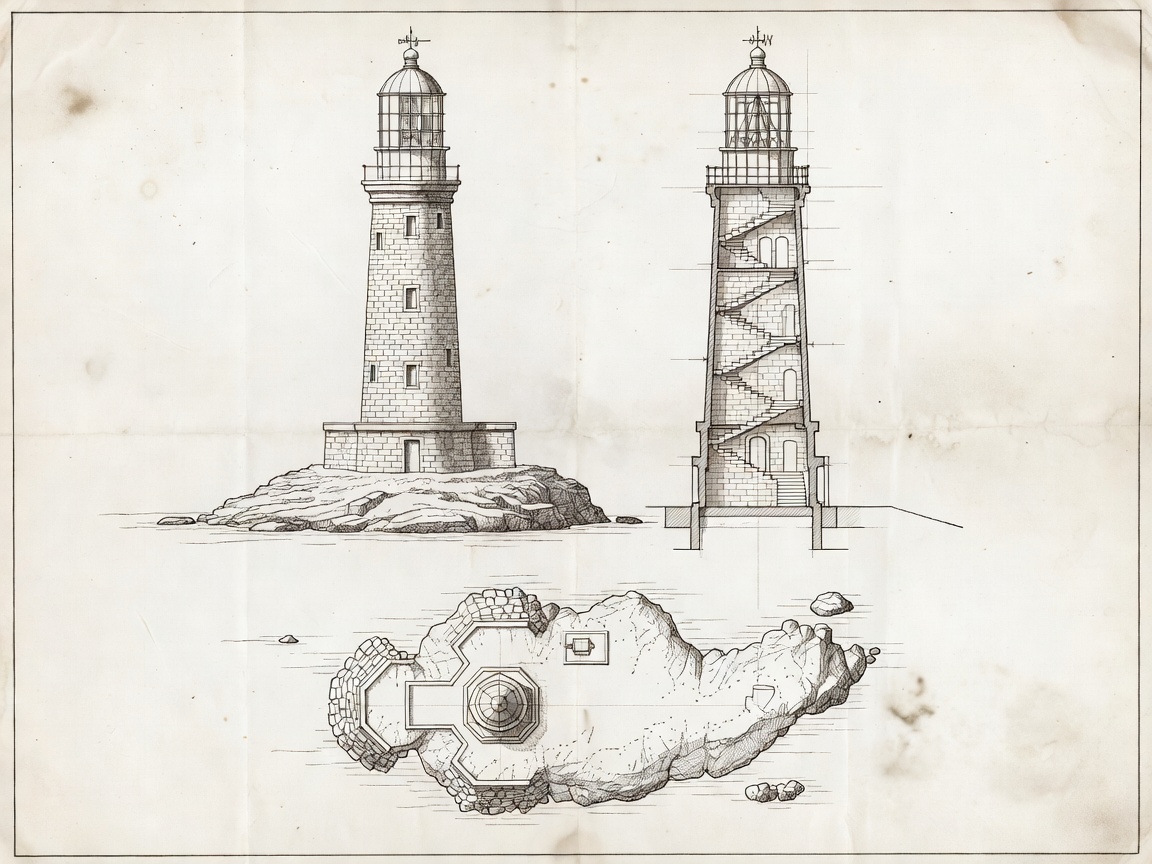
The tower’s answer is weight controlled by shape. A wave-swept tower cannot simply be a pile of heavy material. It must reduce impact where it can and resist it where it cannot. The lower courses grip the rock and each other. The shaft rises in a tapered form. The masonry is cut and fitted so the sea meets an integrated body, not a stack of convenient blocks.
Compared with Bell Rock, Skerryvore pushes scale and remoteness harder. The stones are larger in practical effect because every handling operation is more difficult. The temporary works and landing arrangements become crucial. A crane, a barrack, a pier-like landing or a boat routine is not scenic detail. It is the difference between a drawing and a built station.
Granite suits the duty. It resists abrasion and carries compressive load well. But stone choice alone does not solve the problem. Bedding planes, lifting points, accurate dressing and joint form decide whether the material can do its work. The best block in the wrong place is still wrong. Skerryvore’s masonry is admired because it combines material strength with positional discipline.
Optical purpose
The optic gives the tower its reason. A lighthouse without a clear characteristic is only a monument in a bad place. Skerryvore’s light had to be recognised offshore, where bearings and distances are judged with limited cues. Fresnel lens technology improved the ability to project a concentrated beam. The apparatus also required reliable rotation or screening, clean glass, ventilation and fuel or later electrical support.
Optical design is linked to room planning. The lantern must carry the lens at the correct level. The service rooms below must hold equipment, stores and living space without weakening the tower. Stair routes, hatch sizes and working platforms decide how parts are installed and serviced. A lens can be elegant. Maintenance is not. The design must serve both.
Daymark value remains in play. Skerryvore’s form in daylight tells a ship what it is seeing before the lamp becomes relevant. Colour, silhouette and charted position combine with the night characteristic. The best lighthouse speaks twice: once by shape, once by rhythm.
Maintenance logic
Automation did not make Skerryvore easy. It changed the type of difficulty. Keepers once managed the tower from within. Automated equipment demands power systems, lamps, controls, alarms and periodic access. The visit becomes less continuous but more technical. A remote tower punishes poor planning because each trip carries cost and risk.
The Northern Lighthouse Board’s network approach is central here. Remote monitoring, inspection regimes and standardised equipment reduce the chance that each station becomes its own special problem. Yet Skerryvore remains physically special. Weather windows, landing conditions and exposure still govern what can be done and when.
The field note is blunt. Skerryvore is distance translated into stone. It shows how a lighthouse authority, an engineer and a supply chain meet at a reef. The tower’s beauty follows from that pressure. Nothing spare. Nothing casual. A vertical instrument, fixed where the sea would prefer an absence.