The problem
Eddystone is not a harbour light. It marks danger before shelter. The rock breaks heavy Atlantic water before that water reaches the approaches to Plymouth. The tower has to stand where a normal building has no business standing. Short landing windows. Wet working faces. Salt in every joint. A foundation that cannot be treated as flat ground.
The sequence of towers matters because each one answers a failed assumption. Henry Winstanley’s early timber structure carried confidence and decoration. It also showed that height and visibility do not settle the question of survival. John Rudyerd’s timber tower took a more restrained form and lasted longer, but timber remained vulnerable to fire and decay. The essential move came with John Smeaton’s masonry tower: not simply stone instead of wood, but a different way of thinking about load, profile and connection.
Stone logic
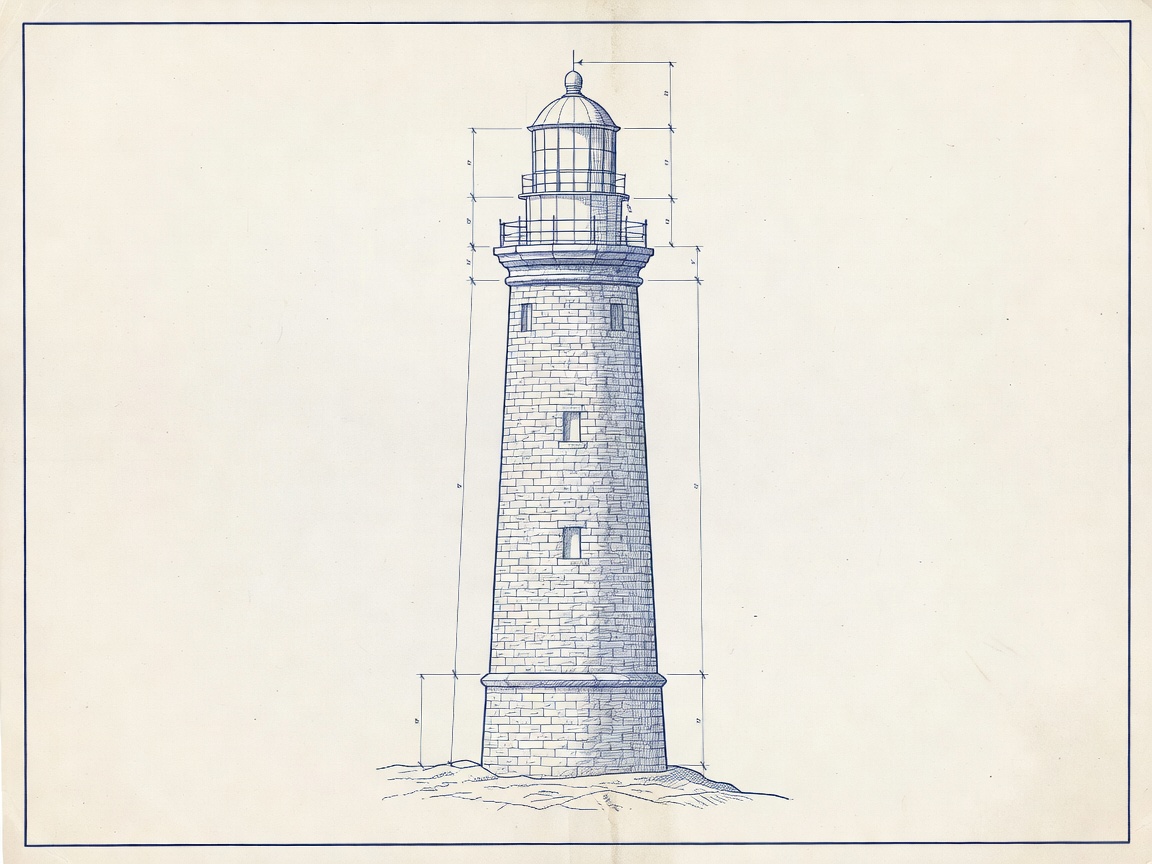
Smeaton’s tower is often discussed for its oak-tree profile. That phrase can make the design sound poetic. The engineering is plainer. A broad base resists overturning. A narrowing shaft sheds wave force. The courses are locked together so that the wall behaves as a mass rather than as loose stacked blocks. Dovetailed stones tie horizontally. Vertical joggles help the courses grip. Hydraulic lime allows mortar to harden in damp conditions, a crucial matter on a reef where dryness is a luxury.
The tower also makes a distinction between foundation and superstructure. The lower courses belong to the rock. They are cut, fitted and bonded into it. Above that, the tower becomes a habitable machine: storage, living space, lantern, access. The living machine only matters if the base remains attached. Later rock towers borrow this hierarchy. Bell Rock and Skerryvore do not copy Eddystone whole, but they inherit the idea that a lighthouse on wave-swept rock must be a single interlocked object.
James Douglass’s later Eddystone tower changes the scale and the detailing. The old Smeaton tower was not discarded as a bad design; its upper part was re-erected on Plymouth Hoe, which is a useful clue. The problem had shifted. More room, stronger masonry, improved lantern arrangements and a different assessment of the reef called for a new structure. The older tower remained a proven ancestor.
Optics and character
Light is not brightness alone. A mariner needs recognition. Eddystone’s value lies in position and character: a known signal on a known hazard. Early lights relied on candles or oil lamps and reflectors. Later practice used more efficient burners and lens systems. The Fresnel lens changed the economics of seeing. It bent and concentrated light with less bulk than a thick solid lens. A rotating or screened apparatus gave a station a pattern that could be charted and distinguished from neighbours.
This is where tower design and optics meet. A lantern needs stability. A lens needs alignment. Fuel, ventilation, condensation and cleaning all affect output. The lantern room is not a glass hat. It is the business end of the building. If the masonry moves, the light suffers. If access is poor, maintenance suffers. If the characteristic is confused with another light, the tower has failed even while standing upright.
Trinity House
Eddystone sits inside the English lighthouse tradition shaped by Trinity House. The organisation’s role is not just ownership or administration. It supplies continuity: dues, inspection, engineer appointment, standardisation, later automation and charted notices. Private initiative appears in early history, but lighthouse reliability eventually demands institutional routine.
Automation changes the station without changing the reef. Keepers once trimmed, cleaned, watched and reported from the tower. Automated operation moves that labour into engineered systems: electric light, reserve power, sensors, remote monitoring and scheduled visits. The romance recedes. The requirement remains severe. A light on Eddystone still has to be identifiable, maintained and trusted from a moving vessel in poor visibility.
The Eddystone lesson is therefore not “build strong”. Too vague. The better lesson: match profile to sea, joint to stone, optic to navigation, and organisation to maintenance. The tower is an answer in granite and routine.