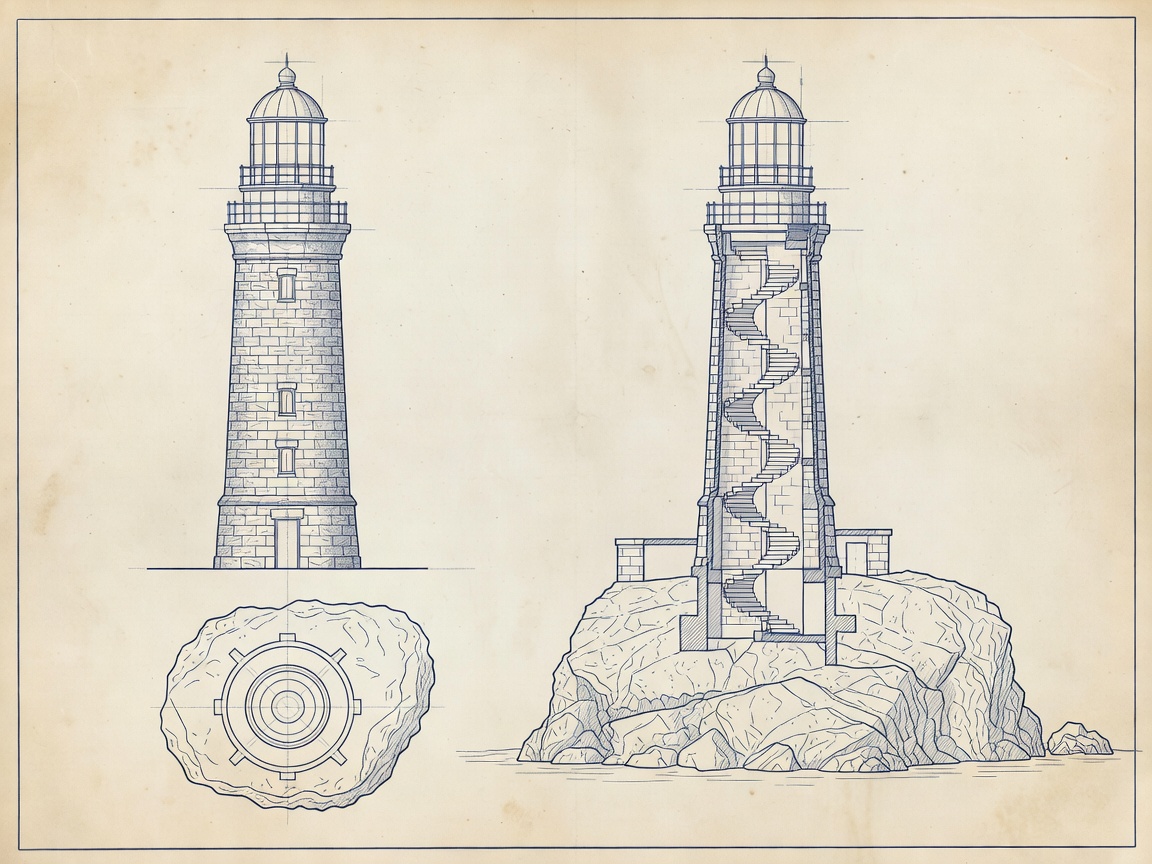
The rock and route
Fastnet is a landfall mark and a danger mark. That double duty matters. Vessels approaching or leaving the Atlantic routes need a clear reference off the Irish coast. The rock itself is hard, exposed and narrow. It offers little comfort to builders and none to careless navigation.
The Fastnet story is often reduced to the romance of “the teardrop of Ireland”, a phrase linked with emigrant routes. The engineering story is sterner. The station has to hold an optic above breaking seas and keep its signal distinct. The rock decides foundation area. The sea decides profile. The authority decides how much risk is acceptable in the existing structure.
The Commissioners of Irish Lights administer the lighthouse network around Ireland. Fastnet sits high in that network’s public imagination, but it still follows the ordinary disciplines of a major light: reliable apparatus, clear characteristic, planned maintenance, notices to mariners and later remote supervision.
Why replacement mattered
The earlier Fastnet lighthouse used a cast-iron tower. Iron was attractive for speed and weight control. It could be fabricated, transported and erected with less masonry work on the rock. That advantage came with questions. Offshore iron structures face corrosion, vibration, joint fatigue and the blunt fact that mass can be useful when seas are large.
The granite replacement is therefore not a stylistic preference. It is a different risk answer. Granite gives weight, durability and a proven language for wave-swept towers. Stones can be shaped to interlock, bed into the rock and create a tapered body. The tower behaves as a massive instrument fixed to its site. This follows the broad lineage of Eddystone, Bell Rock and Skerryvore, while adapting to Irish waters and Irish Lights practice.
Replacement also shows institutional judgement. Keeping an existing tower is always tempting. It is already there. It already carries a light. But a lighthouse authority must think in service life, access, repair difficulty and failure consequence. Fastnet’s granite tower represents a decision that the long-term duty justified a heavier, more durable structure.
Light and fog
The light characteristic is the station’s name at night. Fastnet must not merely shine; it must identify itself. Fresnel optics allowed powerful beams with efficient glass geometry. Rotation or grouping turns light into a coded rhythm. Mariners read that rhythm against charts and light lists.
Fog complicates the neatness. A light can be defeated by air filled with water. Sound signals developed as a companion technology, although sound at sea is less precise than light. Wind, temperature layers and coastline can bend or deaden it. A fog signal is useful, but it is not a magic substitute. The lighthouse becomes a bundle of signals: daymark, light, sound, charted position and radio or electronic aids in later practice.
The lantern space has to serve this bundle. Glazing, ventilation, condensation control, access to the optic, power supply and spare equipment all affect reliability. A remote rock makes every routine task harder. Cleaning a lens, replacing a lamp or checking a mechanism becomes a marine operation before it becomes a technical one.
Irish Lights and automation
Automation at Fastnet is part of a wider shift across British and Irish lighthouse services. Keepers leave. Sensors, electric systems, telemetry and planned visits take over. The human skill does not vanish; it moves. It sits in monitoring centres, maintenance crews, engineers and marine operations teams.
For Fastnet, automation must respect exposure. A remote system still needs redundancy. Power failure, lamp failure, communications problems and storm damage all require planned responses. The question is not whether a person is sleeping in the tower. The question is whether the signal remains dependable and faults become known quickly enough.
Fastnet’s field note is a sequence of choices. Iron for initial practicality. Granite for endurance. Fresnel optics for efficient recognition. Fog signalling for poor visibility. Irish Lights for network discipline. Automation for modern reliability without permanent occupation. The rock remains the same hard fact beneath each choice.