Site behaviour
Bell Rock is a lesson in timing. The reef is not conveniently exposed. It appears and vanishes with the tide. That fact governs everything: landing, quarrying, setting out, boring, dressing, bedding and escape. A lighthouse here is partly an engineering work and partly a clock discipline.
The Northern Lighthouse Board needed a sea mark for a dangerous approach to the Firth of Tay and Firth of Forth routes. The hazard was notorious because it could be invisible when most needed. A buoy can warn, but a fixed light gives stronger position evidence. The difficulty is that the very place needing a light resists the act of building one.
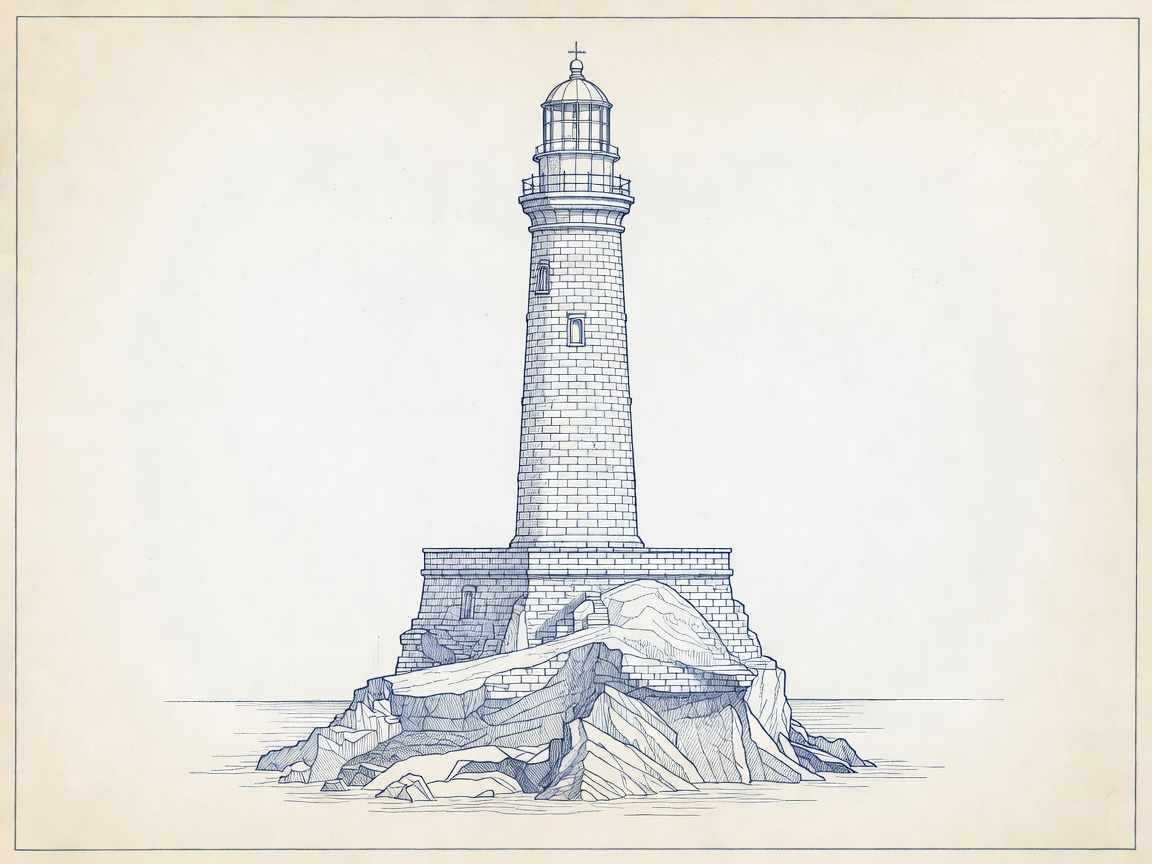
Robert Stevenson’s solution draws from Smeaton’s Eddystone tower but does not merely repeat it. Bell Rock uses interlocking masonry and a tapering profile. It also depends on a temporary beacon and staging arrangements so workmen can retreat when water covers the reef. The permanent tower is the visible result. The hidden achievement is the organisation of minutes.
Building method
Every stone had to arrive with a purpose. Offshore masonry rewards rehearsal. Blocks are quarried and dressed on shore, marked for position, shipped out, lifted and set during the available interval. The foundation courses must grip an uneven rock surface. Cavities and high points are not inconveniences; they decide the seating. The lower work is therefore slow, heavy and unforgiving.
The tower profile follows wave logic. A wide base accepts impact. A curved taper avoids presenting a crude wall to the sea. The mass works with the jointing. Dovetails and joggles prevent individual stones from becoming separate projectiles under uplift and shock. Mortar helps, but geometry carries much of the duty. The lighthouse is a locked stone vessel.
Logistics matter as much as drawing. A design that cannot be assembled in tidal fragments is not a design for Bell Rock. Boats, cranes, temporary rails, smithing, food, shelter and signalling all become part of the engineering system. Modern readers often separate construction plant from final structure. On Bell Rock the distinction is thin. The finished tower exists because the temporary works were planned with equal seriousness.
What differs from Eddystone
Eddystone helped prove the value of interlocked masonry. Bell Rock sharpened the method under harsher access conditions. The rock’s tidal character made the working day shorter and more conditional. That pushed the project towards strict prefabrication and exact placement. It also made the keepers’ later life unusually exposed. The tower was not near a casual landing. It was a roomed column in moving water.
The lantern and optic belong to the same practical chain. A North Sea reef light needs recognisable range and rhythm, but the tower must house the apparatus securely. Fresnel optics later improved light concentration across lighthouse networks. Before and after such improvements, the need was stable support, clean glazing, fuel management, ventilation and a characteristic that did not mimic another nearby light.
The visual daymark also matters. A lighthouse is read by daylight as a shape and by night as a rhythm. The tower’s proportions, colour treatment and charted position combine. Bell Rock’s exposed simplicity suits that purpose. Nothing decorative is needed. The sea supplies enough emphasis.
Operation and automation
The Northern Lighthouse Board’s role gives Bell Rock its administrative frame. It is the general lighthouse authority for Scotland and the Isle of Man. That means the tower is not an isolated heroic object. It is one node in a managed network of lights, buoys and beacons.
Automation alters daily labour. Keepers once maintained burners, lens surfaces, stores and weather observations from within the tower. Automated systems shift those tasks into electrical plant, reserve arrangements, alarms and scheduled service visits. The station still has to fail safely. A dark light on a charted danger is not a small inconvenience.
Bell Rock’s continuing lesson is exactness under constraint. The reef gives little time, little comfort and no forgiveness. The answer is not scale alone. It is matched stone, planned lifting, a reliable optic, a distinct characteristic and an authority able to maintain the whole arrangement long after the masons leave.